

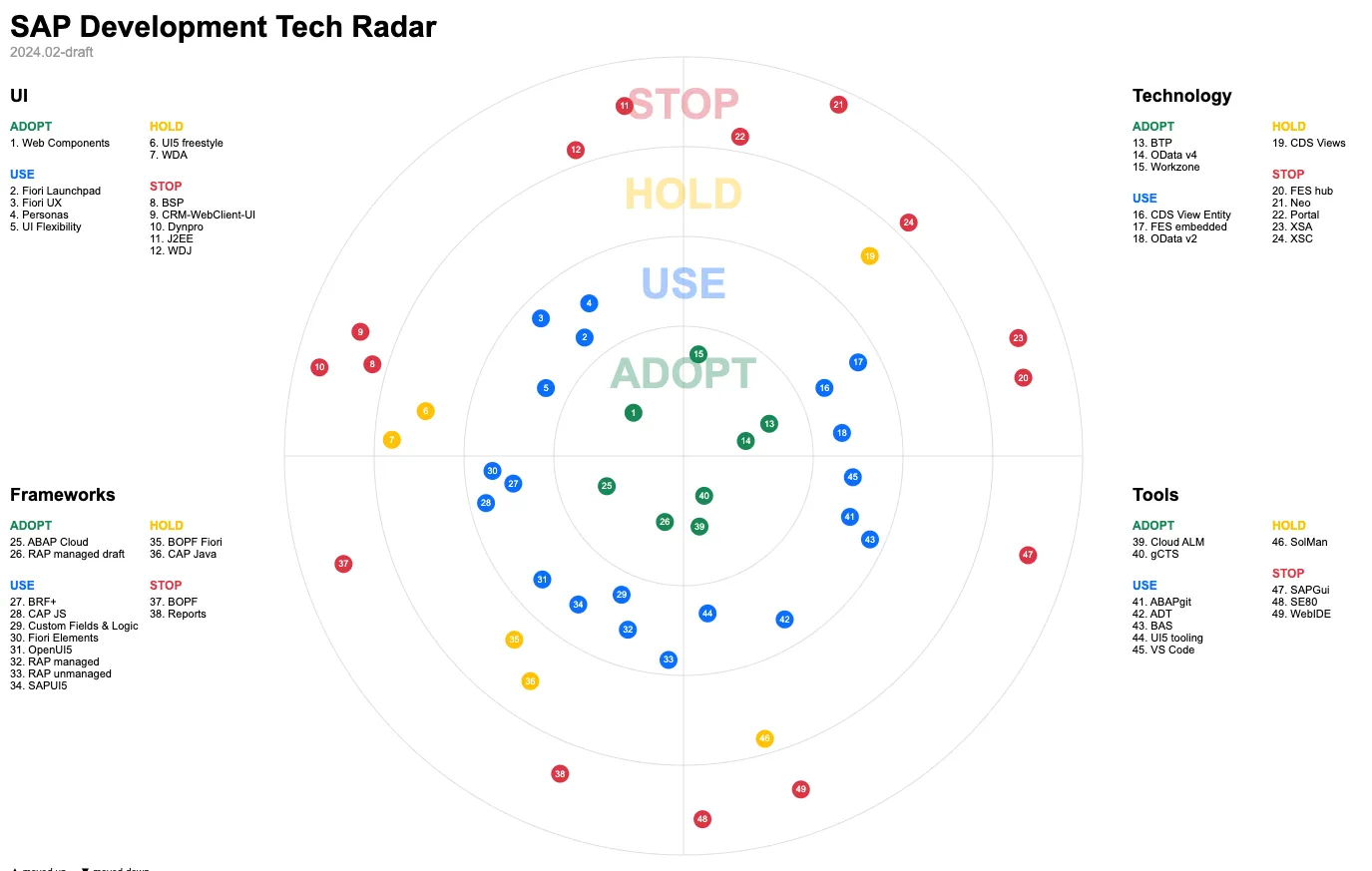
The SAP Development Tech Radar is available online 🔗. The source code is available at its GitHub repository 🔗. The information used for to place each technology on the radar is in the folder definitions 🔗.
Purpose
The SAP Development Tech Radar (SDTR) lists the usage recommendation for SAP development relevant technologies (mostly) from SAP. The README 🔗 provides more information on how to read and interpret the SDTR.
The SDTR achieves its goal when SAP developers are using it to question their current available tech stack. If there is no plan to get to the possibility to use the tools in ADOPT or USE, this should raise serious doubts about the customers SAP strategy.
Usage
The target of the SDTR is to show easily what should be used for SAP development. It is, however, not a product evaluation or recommendation, nor does it rate the quality of the tech stack available to SAP developers at customers. It rather shows if actions should be taken to replace a technology or to not use it for new projects. It is not stating what to use for a project.
The SDTR takes inspiration from thoughtworks tech radar 🔗 (TTR). Attention: using the SDTR like the TTR won’t work. For instance, while for the TTR adopt means that this item should be adopted (by the industry), for the SDTR adopt means that it should be tried out in a project (by the SAP developer or customer). Even when an SAP developer is only using technology listed in HOLD or STOP this is per se not bad. HOLD or STOP for the SDTR means that if a strategy is in place to maybe replace it, there is no risk. The technologies listed there are of course not the best fit for new projects. USE in the SDTR represents a general recommendation, or best practice, that this technology can be safely used in any project.
The items listed are mostly from SAP. Only in exceptional cases where the benefit for SAP developers is, without understatement and doubt, incredible, it is added. That is simply because SAP technology is normally just there. CDS Views, RAP, BOPF just come with a certain NetWeaver release. Developing BTP apps normally comes with BAS, or the option to develop CAP apps. 3rd party software however is not available across most SAP customers simply because they are SAP customers.
Versions
The SDTR cannot be static. The best practice applicable for S/4HANA 2023 is different than it was for ECC 5 development. Technology evolves, SAP is introducing new technology, and as well is retiring it. The SDTR must reflect these changes, and they are maybe occurring more often. Therefore, the idea is to have a new release published at least twice a year. This release is than reflecting the current view on technology for SAP developers. Keep in mind: this is version independent from what the developers have available at their work environment.
Later versions can show how a technology performed over the versions / years. This allows architects to validate how their strategy performed. For developers this will reveal how their tech stack evolved over the years.
Participate
The SDTR cannot be maintained by a single person (currently: me). To get the most benefit from it, it must represent the opinion from a larger SAP developer audience. SAP developers are invited to contribute to the SDTR. The repository contains more information on how to contribute 🔗. The short version is: add / change a technology definition, get it merged, then voted for (tbd) and have it added to the next published version. Technology cannot simply added, some QA must be fulfilled, like: supported, relevance or usage. That’s why currently no Build (AppGyver) or Build Code (with AI) is listed. But it could be added in the current proposal collection phase. If there is proof that it is relevant, it will be added.
At the current branch for adding changes 🔗 to the next (and btw first) published version 2024.06 are already some items 🔗 added, like ATC 🔗, SEGW 🔗. I hope the documentation is good enough to understand how to contribute and how the process works.
Curious how the voting will work? For the next release 2024.06 it still might be an invitation only process. There is work going on to found an association (German: Vereinsgründung wird gerade aktiv vorangetrieben. Dann können die Mitglieder über die Einreichungen mitentscheiden).