

- July 2026 was the day of UI5con 2026 🔗. As usual, the main track was live-streamed and remains available on YouTube, while the sessions in W1/W2 were recorded and will be made available shortly. The agenda is still online. Since the websites for previous editions were removed and now redirect to YouTube playlists, you might want to go through the current agenda and sessions before the website is updated for UI5con 2027.
New and newsworthy
Compared to the keynotes of previous years, the focus was not on UI5 core features or internals. Instead, the spotlight was on how to use UI5 in the age of AI—how to write UI5-based apps with AI and how to modernize your existing apps. What do you get from SAP and the UI5 team? From an agentic coding perspective, UI5 is ready. The partnership between SAP and Anthropic was clearly visible, with Claude Code being featured everywhere. This is currently the go-to AI coding tool for UI5 development teams at SAP. However, this does not mean other platforms are ignored; they are also supported through tools provided with a coding-agent-agnostic approach. It will be interesting to see how long the focus on Claude lasts once the partnership ends or the costs become too high.
For the first time since 2022, there was no mention of UI5 2.0 in the keynote. This was explained later that day during the “Ask UI5 Anything” session. UI5 2.0 will not be coming. This is not a “rest in peace, UI5 2.0,” but rather a clear signal that a UI5 2.0 version is highly unlikely in the foreseeable future. The work done over the last year to lay the foundation for UI5 2.0 is still available. While OpenUI5 may have an open-source license, it is ultimately one company that steers the ship—and currently, SAP’s sole focus is AI. Since resources are not unlimited, SAP cannot pursue AI initiatives and support UI5 1.0 and 2.0 across all different channels simultaneously. AI wins. SAP has decided that AI is strategic, and everyone else must follow. A topic that has been pushed as much as UI5 2.0 over the last few years demanded a spot in the keynote; the decision against version 2.0 should — no, MUST — have been included. I guess no one at SAP is happy about this decision. But putting it at the end? I hope the UI5 team learned its lesson and now knows its stakeholders and their expectations.
My lesson learned: wait until something is actually released and established. Just because something is featured in the keynotes of 2022, 2023, 2024, or 2025 does not mean it won’t get consumed by a shift in corporate strategy.
Any pressure to change your UI5 apps is gone with this shift. If you were in the process of preparing your “legacy” apps to move to UI5 2.0, you can stop. Save your efforts for other things. There is no immediate need to modernize every UI5 app hoping to be ready when UI5 2.0 lands. Semantic versioning means they will continue to run for years to come. You will only need to make the standard adjustments required when upgrading from 1.38 to 1.120 or anything newer. As long as your goal is to keep an app working, your effort will be close to zero.
This also means you can save your AI tokens. Modernization was demonstrated later in more detail in a separate session.
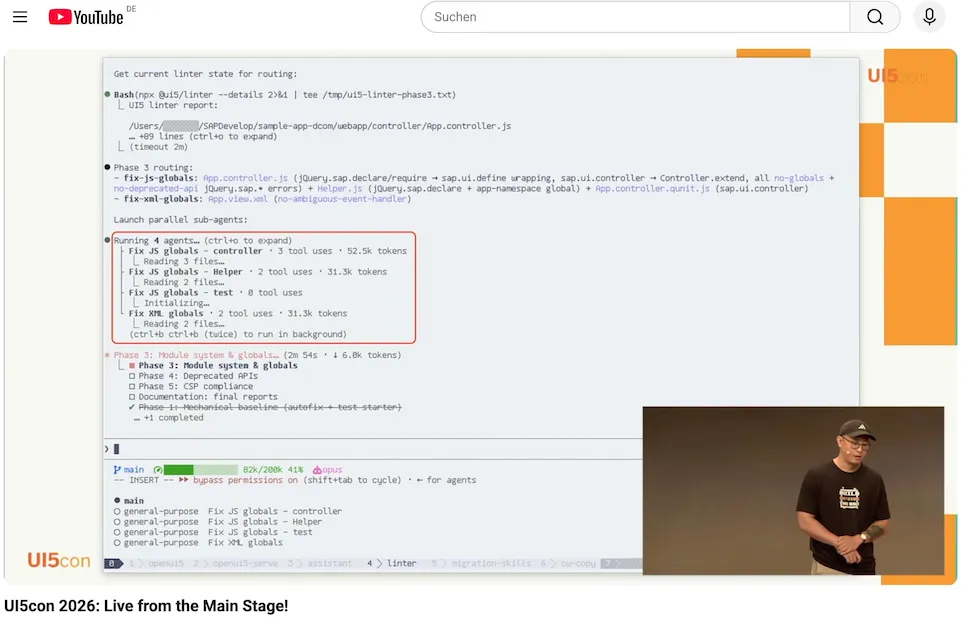
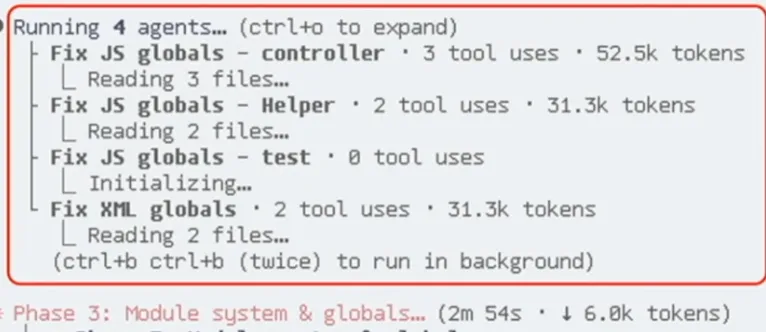
The token usage required to modernize seems high. I will have to watch the recording again. Spending over 100,000 tokens to modernize a single app? Sure, it works, but what kind of app was that?
Lessons learned
With UI5 2.0 removed from the roadmap, modernizing UI5 apps should now mean rewriting them as Fiori Elements apps. Why? Applying best practices to a freestyle app means it remains a freestyle app 🔗. If you are going to modernize, do it right: update your backend, implement OData v4, and rewrite your app using Fiori Elements 🔗. The biggest benefit of this approach is that you are legacy-free by design. The framework takes care of your app, making future updates a zero-effort task. Fiori Elements is essentially the “clean core” approach applied to UI5-based applications.
Offline
Offline UI5 has been rediscovered by SAP. Perhaps not 100% true offline, but a “little bit” offline—good enough to work for simple scenarios. Not sure if this lite approach will match expectations. Here, I have to share another lesson learned: this likely won’t survive or reach a mature state. We were there years ago, and it was killed by SAP strategy. SAP wanted to tackle offline capabilities, and we ended up with MI, MBO, HWC, Kapsel, Fiori for iOS/Android, and MDK — a massive collection of SDKs and mobile platforms, but nothing more from the UI5 side. Aside from a few community ideas, that was it. Since SAP still wants to sell its mobile platform 🔗, offline UI5 will face an uphill battle. Furthermore, the future of Fiori apps is Fiori Elements. Offline functionality must work seamlessly for Fiori Elements apps; if it doesn’t, adoption rates will be even lower.
As long as there is no clear corporate decision that offline is coming for both freestyle and Fiori Elements, and that this is a core part of the mobile strategy, I am going to apply my lessons learned from UI5 2.0: I will only consider it once it is officially released, available, and widely adopted.
JSX
Hello React developers. JSX 🔗 might be coming to UI5. Following JSON view 🔗, HTML view 🔗, JavaScript view 🔗 and XML view 🔗, we might soon see JSX / TSX. So far, only XML view have survived 🔗. This decision — assuming it survives the current AI focus — could help UI5 attract non-SAP developers. However, I suspect it will not work out as expected. It has the potential to make it even easier for non-UI5 frameworks to integrate feature-rich UI5 controls. JSX might just become next-level Web Components (i.e., “thanks for the UI control, we’ll take it from here”). Since JSX is incredibly well-documented, this could trigger a funny modernization path: moving from XML to JSX via AI, and then from UI5 to React in the very next step.
By the way, it was surprisingly quiet regarding Web Components. Compared to previous UI5con editions, they were barely mentioned. This could be a good sign, indicating that the technology is established and just works. Or… attention is simply shifting from Web Components to something else, like JSX/TSX. The last update I saw was last year, where the consensus on Web Components was: you can use them, but do not expect them to work exactly like “native” UI5 controls. It would have been great to see more demonstrations of how Claude Code can create an Angular, React, or Vue app using Web Components.
UX
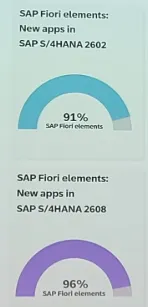
SAP’s alternatives were not mentioned. There is Fiori, which can be built using UI5, but also via Fiori Elements and Fundamentals. Now, there is the new compositional design system 🔗. With AI now taking over, I expect GenUI 🔗 to win, meaning SAP’s budget and resources for the coming years will focus heavily on GenUI, followed by Fiori Elements. The sheer number of Fiori Elements apps in each S/4HANA release speaks for itself. This leaves UI5 with the primary task of supporting Fiori Elements and its surrounding enterprise features: flexibility, accessibility (a11y), internationalization (i18n), and long-term support—which is currently their unique selling proposition.
I won’t be surprised if the content presented at UI5con 2027 shifts significantly toward UI and AI, focusing on how UI5 can help build great UX in an AI-driven environment. Let’s see how much longer UI5con remains about UI5 itself, rather than UI and UX within AI solutions. Content-wise, I would actually see this as a positive evolution. Most UI5-based apps run in real-world business scenarios, and UI5 developers are ultimately hired to solve business problems.