

The news coverage was not always positive about AI. You could often read that AI is going to kill jobs. The message was that massive layoffs are going to happen. And so far, this is true. In 2026, it was hard not to read news about another realignment of resources. Normally it came with the note that another x% of jobs were cut at a company. However, the tone and outlook changed in 2026. It was no longer about the “normal” white-collar worker. Now it is developers that are threatened by AI.
Jobs are wiped out
The improvement LLMs made in 2026 regarding development tasks is breathtaking. In a few years, the LLM capabilities went from being able to refactor a simple method or writing Asteroids to writing complex programs. Sure, not quite perfect, but more than good enough. Seeing that this improvement allows companies to replace developers caught the attention of the press. Be it IT-specialized magazines or general news, the coverage shifted to include that developers - mostly junior developers - can’t find a job, while senior staff are being pushed into retirement. To some degree, the articles have difficulty hiding their “Schadenfreude”. Understandable, as a significant number of their readers are part of the white-collar workforce, middle management, the ones currently being replaced by an AI agent. Those are the same people who heard for years that they would be replaced by a simple script. Written by a developer. The irony here is: the ones who started the revolution (developers) are now affected by what they started. The people who kept telling others a script would replace them are now being replaced by a script. No wonder this point of view gained momentum. Pleasing the audience is part of a writer’s job.
And yes, IT jobs are currently wiped out globally. The next years will be super hard for new hires. Fresh graduates from university will find out that the easy entry-level tasks are now done by AI. What the news fail to communicate is that the problem is not finding an entry job. The problem is finding an entry job that needs a person and that is adding value to a company. It is the same as for the middle management jobs: the focus is changing. Tasks are changing. The value evaluation is changing. Finding a new job is hard because you now need to deliver business value that you simply cannot as a new hire.
LLMs are good at processing text. That is: everything that can be defined in text can be done by them. Faster than a human can. Even when the LLM makes errors, making and fixing them is still faster than waiting 3 days for a human to come up with the first draft. An LLM does this in minutes. Hard to compete with that.
Technical skills
A developer who learned how to center a div vertically once had a valuable skill. Knowing how to transform a design into code was a skill.
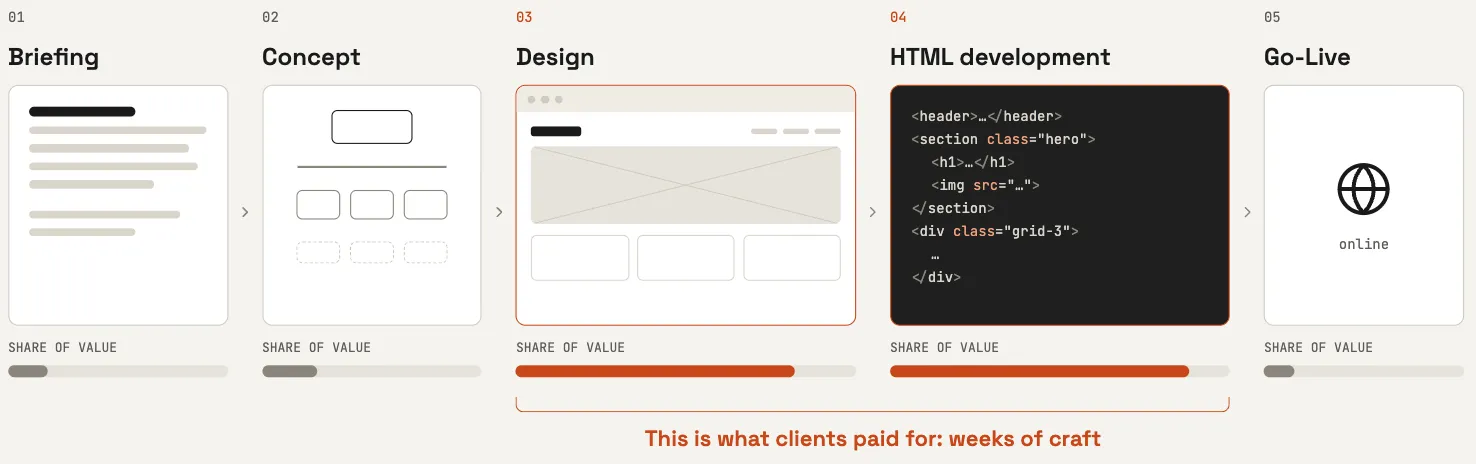
The value for which a company paid was to realize an idea. The real value for the business was at the beginning, the concept of what to do, and the site that went live. All the coding between was just necessary overhead. However, the majority of money was spent there. It was something a company could not skip. There were always tools available that tried to make it easier to create a site. But still: it was an additional step everyone had to go through. But what companies paid the most for - in money, time and people - was not the concept. It was the development.
Throughout the development phase, many additional tasks were included to make the result work: clean code, responsive design, layout, etc. The focus was often on what the developers and implementation partners knew best. Knowing which design to choose, framework specialties, CSS hacks, the contrast of text and background, responsive designs, etc. is certainly a skill. But it is a skill that can be written down and then picked up by an LLM. It is a skill, not necessarily of value to the business.
Technical quality
As a result, the delivered solutions looked good, but lacked quality. Not technical quality, but business quality. The teams that developed the site were good at what they did. The site is responsive. The site follows clean code and other development guidelines. It can be maintained. As the teams are rarely also business experts, the site lacks business knowledge. How to present the information? Which information is needed at this specific step for an informed decision?
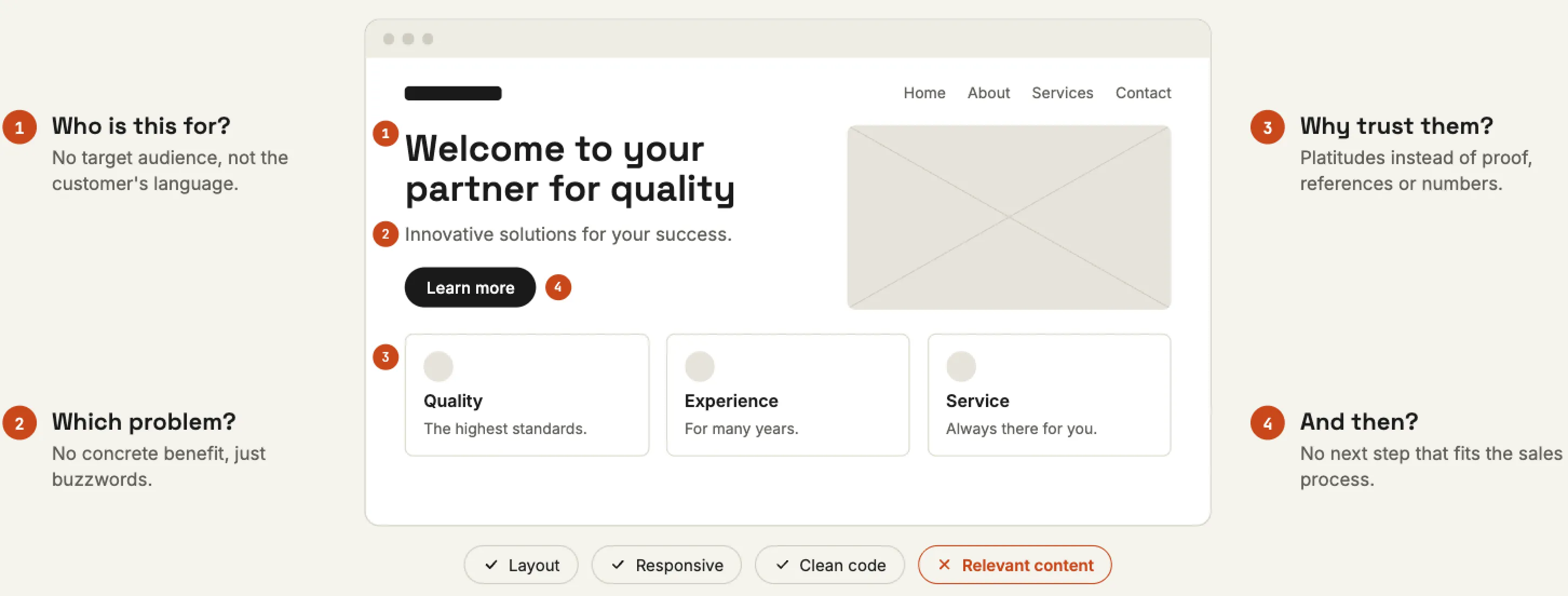
The usual fix is to bring business input back into the development process: work iteratively, deliver a new version regularly, and have it reviewed by the functional teams and end users. You again get several layers of complexity between the end user and the one who is implementing the solution. What else would you expect? There are many people working at companies ensuring that the end user is rarely contacted by the ones making and delivering the solutions for them. Corporate culture eats strategy for breakfast.
Business value
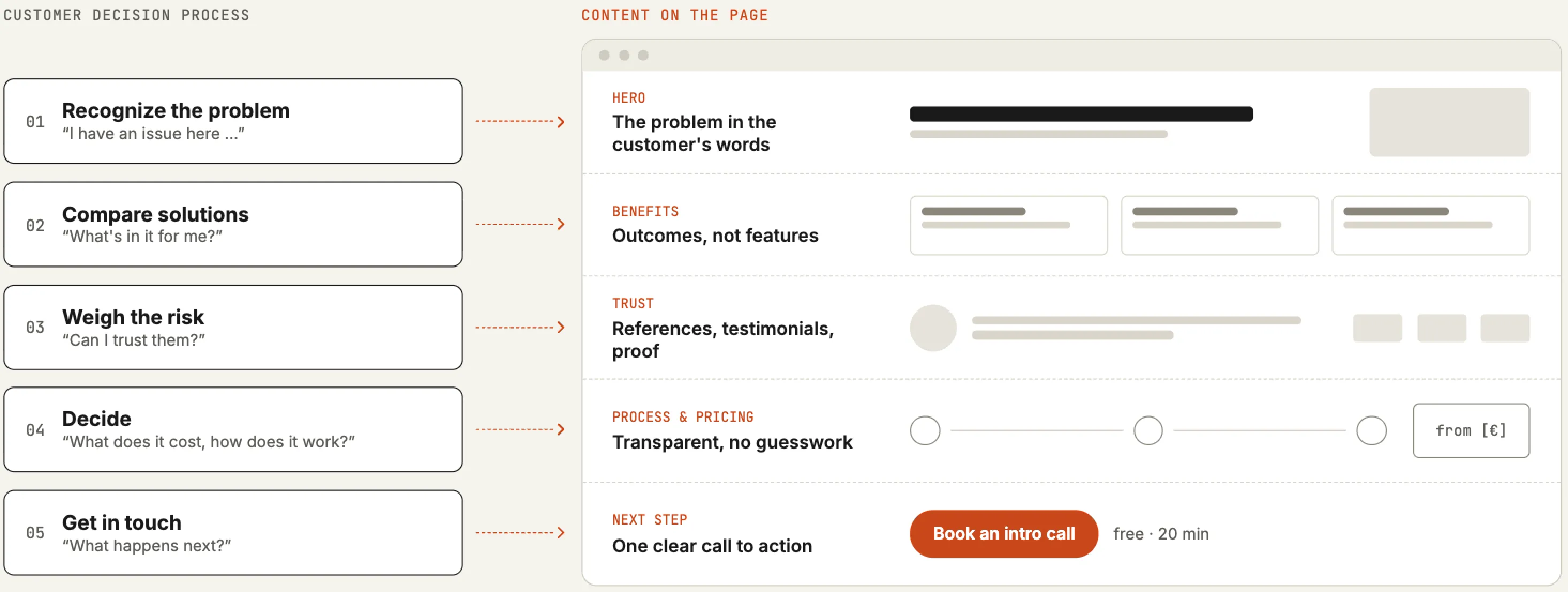
AI now lets companies reduce these layers. The time-consuming process of going from concept to POC via walking skeleton to MVP to a draft version and so on is reduced to going directly to a working version. Focus on value.
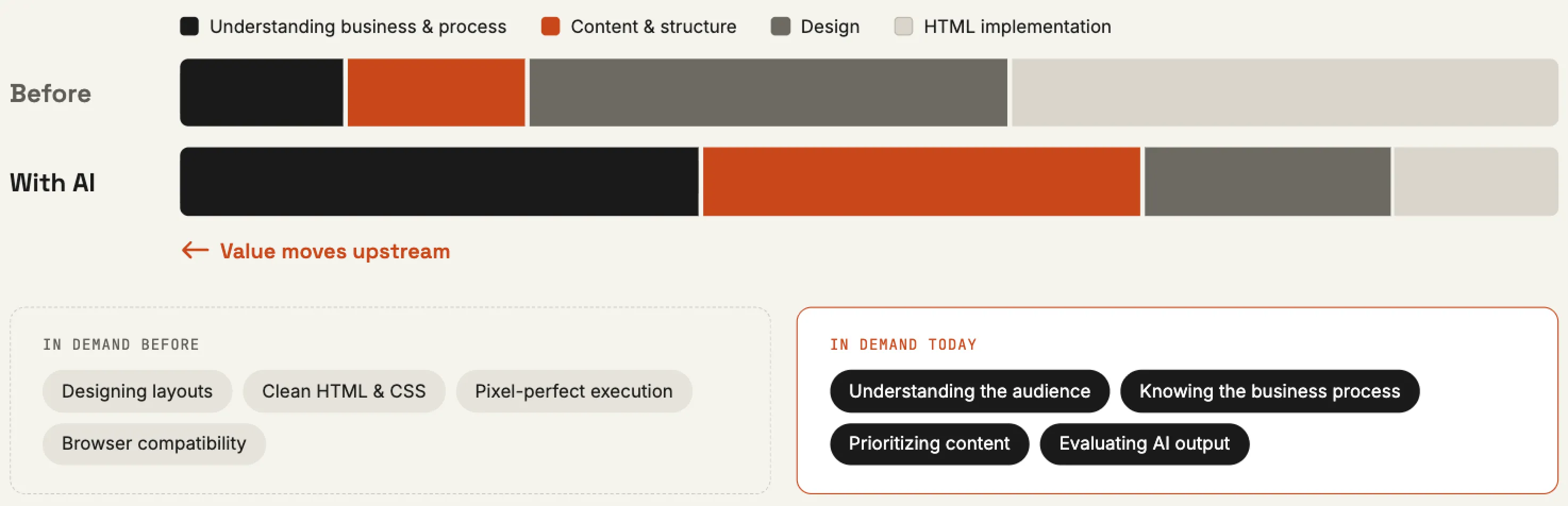
And this shift in value is what is killing jobs. Not just IT jobs, but everywhere. For instance, a journalist whose first job was to summarize other news, or to sort out unrelated news: that entry job is gone. A white-collar worker whose first job was to read through logs and reports and summarize them: gone. The developer learning how to center a div, how to write a unit test: gone. The designer who made sure that the heading title also looked good on smaller screens: gone.
The ones who can answer the question of why certain information is needed in a given process step, what is needed to make a person click on the proceed (or buy) button, who know the business, the process: these are going to stay.
Developer value
What does this mean now? Be honest with yourself. Your skill is HTML5? You know a JavaScript framework? You know CSS and some design guidelines like material design? If that’s all you know, you are in trouble. You are in the same position as someone who sums up reports or goes through Excel files looking for patterns. You are replaceable. You do not add business value.
Change this. Now.
Acquire the implicit business knowledge, the kind that cannot easily be written down. Be the person who knows why those patterns matter. Be the one who knows what to do with the reports, the one who knows what those reports, and the information in them, are actually worth. For IT this means: know what a design means, why it does what it does. What’s the value a given framework provides. Remember: code is a commodity. Rewriting a website from Angular to React or to plain HTML is just tokens. The question you need to be able to answer is: what does each choice do better? What’s the benefit of choosing one framework over another? That’s knowledge. Reminder: personal preferences are not knowledge. They are just a subjective answer to an objective question.
And business likes objective answers.
What does this mean for you now? Ask yourself: did you make money writing code? Or were you paid for answering business questions? Were you invited to customer meetings because of your understanding of the business domain and your expertise and how to solve it in code, or just because you were the IT guy who wrote the website?
SAP skills
That’s good news for SAP developers. Or rather: SAP consultants. The SAP universe often feels different from the rest of the IT world, because it is different. A good SAP consultant not only knows how to code. It is part of the job to know when a COMMIT WORK happens and why, when a draft is created, and what needs to be checked before it can be saved. This knowledge is mostly learned by doing and rarely well documented, not even by SAP. What are the business requirements an item needs to fulfill to proceed to the next status? Things that any SAP consultant learns early on, like number ranges and domain modeling, are skills you cannot expect from, say, TypeScript developers. SAP coding is close to business: processes, modeling, domain. That makes it easy to deliver value. Sometimes the developer knows the business side better than the functional key users do. And business process knowledge is often implicit. Why does a process work here but not for another company? What are the details that no one can describe objectively, yet that make it work for a company? What kind of knowledge is exchanged between people? When do you need to read between the lines to make it work?
That doesn’t mean everything is OK. Changes are happening in the SAP universe too, and AI is catching up fast. The role of an SAP developer will change too. Therefore, keep your skills and find new ones. Knowing how to test the business outcome of a solution will be in high demand. Does the solution offer what the business needs? How to validate this? What will the business gain when a process is changed? And where does this make sense? As you can see, the business side will gain more attention. This should be easy for SAP consultants as business has always been part of our role. But now it will become clearer that SAP development is about business.
Companies
Companies now need to understand that part of the business value is investing in the future. Even if a new hire, fresh from school, college or university, cannot offer all the knowledge needed for a job, hire them anyway. These are your future senior staff, the ones who will acquire all that implicit knowledge over the next years and decades. If they are not hired today, there will be a gap in 10, 15 or 20 years that cannot be closed.
Will AI kill your job?
And what about all those developers that already have some years of experience? That maybe see themselves as a senior?
AI won’t kill your job. Addendum: when your job offers value to the business.
If you are billed by the hour for producing code, if your job is to produce code, you are not expected to question the business value behind it, and are not asked to influence the business process: yes, AI will kill your job.
But it isn’t AI that decides this. It is the way the job was defined. Anyone who accepted being the one who only turns well-defined tasks into code was replaceable long before AI arrived. AI just made it visible.
For everyone else: AI will transform your job.